
POI Interconnection Engineering: The Complete Guide to Connecting Generation to the Grid
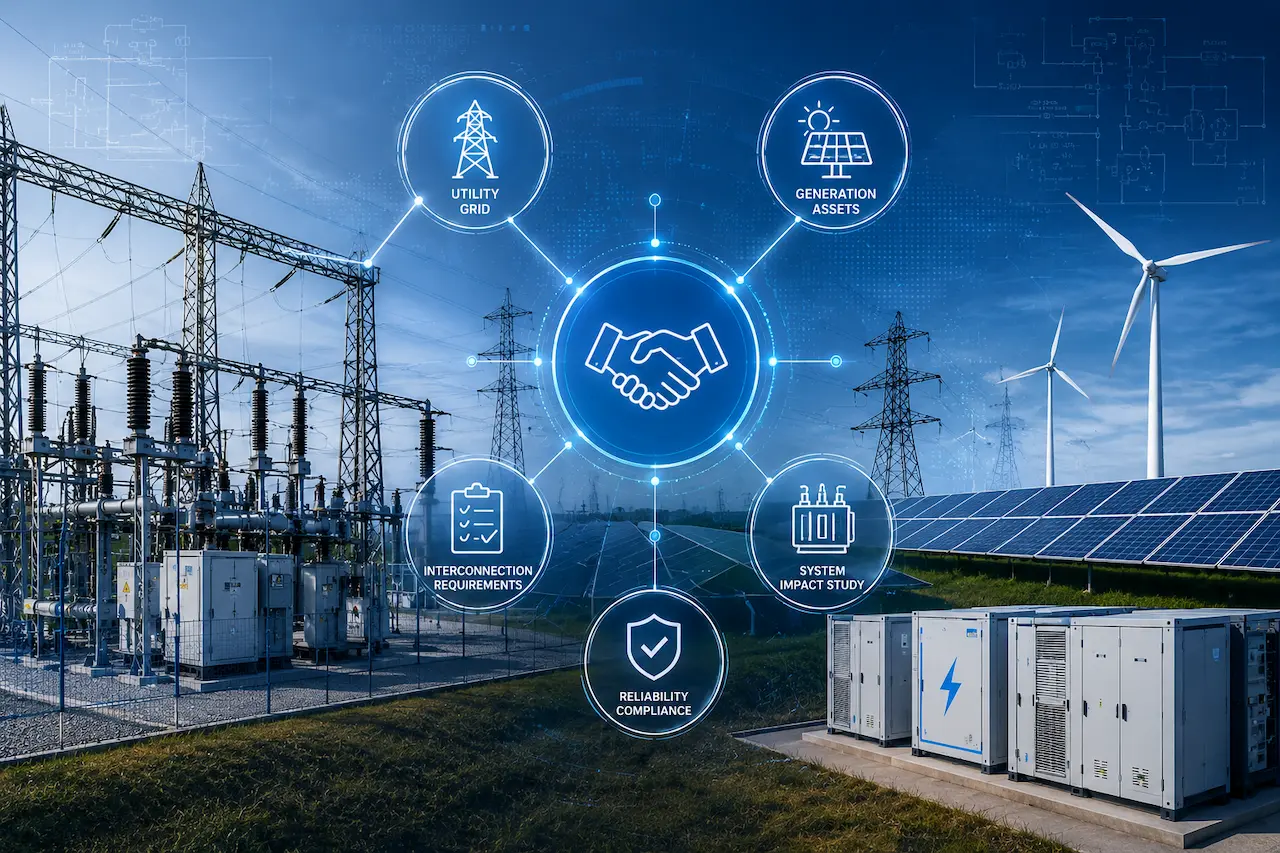
The Point of Interconnection (POI) is where your generation asset meets the transmission or distribution grid and the engineering work required to successfully navigate the interconnection process is both technically demanding and critically important for project economics and timeline.
Interconnection costs are one of the largest uncertainties in renewable energy project development. Projects have been cancelled by unexpected upgrade cost assignments; others have been saved by skilled engineering that identified alternative interconnection approaches that reduced costs by tens of millions of dollars.
This guide explains the interconnection process, the engineering work involved, and how American Power Engineers helps developer and generator owner clients achieve successful interconnection outcomes.
Understanding the Interconnection Process by ISO/RTO
The interconnection process varies meaningfully across the major ISO/RTO territories:
PJM Interconnection Process
PJM operates a cluster-based interconnection study process where projects in the same geographic area and study window are evaluated together. Key characteristics:
Need Engineering Support for Your Power Project?
American Power Engineers delivers power system studies, substation design, renewable energy engineering, BESS projects, NERC compliance, MEP engineering, and POI interconnection services.
Explore Our Engineering Services- Transitional cluster study process: PJM is implementing a new accelerated study process following FERC Order 2023 compliance
- Cost allocation: Network upgrade costs are allocated based on flow contribution analysis
- Timeline: Typically 3-5+ years from application to execution of Generator Interconnection Agreement
- Queue management: PJM’s queue contains thousands of projects; active management of your queue position is important
MISO Interconnection Process
MISO uses a Definitive Planning Phase (DPP) cluster study process:
- DPP clusters: Projects are grouped by vintage and geography for coordinated study
- GIA execution: Following DPP completion, projects execute Generator Interconnection Agreements specifying upgrade requirements and costs
- MISO’s Direct Connect Policy: Direct connection to the MISO-owned transmission system has specific requirements and timelines
ERCOT Interconnection Process
ERCOT’s interconnection process is managed through:
- Standard Generation Interconnection Agreement (SGIA): The primary contract governing interconnection terms
- Generator Interconnection Study (GIS): ERCOT’s study process evaluating system impacts
- NOGRR 245 compliance: All new ERCOT-connected IBRs must comply with NOGRR 245 ride-through requirements (see our ERCOT NOGRR 245 guide)
CAISO, NYISO, ISO-NE, and SPP
Each of these ISOs operates its own interconnection process with specific study requirements, cost allocation rules, and technical standards. American Power Engineers has experience across all major ISO/RTO territories.
Engineering Work Required for Successful Interconnection
Interconnection Request Package Development
The interconnection request package must include accurate technical data about the proposed facility. Errors or omissions in this package can cause study delays or, worse, lead to incorrect study results that misstate upgrade costs. Our team ensures your request package includes:
- Accurate facility ratings (MW, MVAr, power factor range)
- Correct equipment specifications (transformer impedances, IBR model parameters)
- Realistic commercial operation date commitments
- Complete site location and POI identification
Power Flow Model Development
Your facility must be represented in the ISO’s power flow base case models for study purposes. This requires developing a PSS/E (or equivalent) positive-sequence model of your facility that:
- Correctly represents transformer configurations and tap settings
- Models reactive power control modes accurately
- Interfaces with the existing power flow model without convergence issues
Dynamic Model Development
For stability studies, a dynamic model of your facility is required. The DMDG requirements of each ISO specify the required model components and model parameterization. Our power system studies team develops compliant dynamic models for all major generator and IBR technologies.
Planning a Solar, Wind, BESS, or Grid Interconnection Project?
Our engineering team helps project owners, developers, utilities, and facility teams move from technical planning to reliable project execution.
View Engineering ServicesTechnical Study Review and Negotiation
When ISO study results are published, they require careful technical review:
- Are the network upgrade triggers correctly identified?
- Are the upgrade costs consistent with engineering estimates?
- Are there alternative interconnection configurations that reduce upgrade requirements?
- Are there opportunities to coordinate with other queue projects to reduce individual upgrade allocations?
Skilled technical review of interconnection study results has saved our clients tens of millions of dollars in upgrade costs through identification of errors, alternative configurations, and coordination opportunities.
Interconnection Facilities Engineering
Once the Generator Interconnection Agreement (GIA) is executed, detailed engineering of the interconnection facilities (the physical infrastructure at the POI) can begin. Typical interconnection facilities include:
High-Side Switching Station: Transmission-voltage switching equipment at the POI, typically including circuit breakers, disconnect switches, and CTs/VTs for protection and metering.
Revenue Metering: ANSI-standard revenue quality metering meeting applicable ISO tariff requirements. Revenue meters must be installed, tested, and certified by qualified metering personnel.
Interconnection Protective Relay (IPR): Protection relay at the POI, typically installed and maintained by the Transmission Owner but with settings that must be coordinated with the Generator Owner’s protection system.
SCADA/Telemetry: Communication link between the facility and the ISO/RTO control center for real-time monitoring and control.
Final Thoughts
The Point of Interconnection is where good engineering pays for itself. Interconnection costs remain one of the biggest sources of uncertainty in power project development, and the difference between a project that stays on budget and one that gets cancelled often comes down to how carefully the request package, power flow model, and dynamic model were built in the first place and how closely the study results were reviewed afterward.
Every ISO/RTO territory has its own process, timelines, and cost allocation rules, but the fundamentals are the same everywhere: accurate technical data in, careful review of study results out. Projects that treat interconnection engineering as a formality to get through tend to discover expensive surprises at the worst possible time. Projects that treat it as a technical discipline — with the same rigor applied to model development, study review, and facilities engineering are the ones that reach commercial operation on schedule.
FAQs
What is a Point of Interconnection (POI)?
The Point of Interconnection is the physical and electrical location where a generation or storage facility connects to the transmission or distribution grid. It’s also the point at which ownership, protection responsibility, and metering typically transition between the generator and the transmission/distribution owner.
How long does the interconnection process typically take?
Timelines vary by ISO/RTO, but it’s common for the process to take three to five years or longer from initial application to execution of a Generator Interconnection Agreement (GIA), particularly in cluster-based study regions like PJM and MISO.
Why do interconnection costs vary so much between projects?
Network upgrade costs depend on where a project sits in the queue, what upgrades are triggered by its interconnection, and how those costs are allocated among projects sharing the same study cluster. Errors in the interconnection request package or missed alternative configurations can also significantly inflate assigned costs.
What’s the difference between a power flow model and a dynamic model?
A power flow (positive-sequence) model represents your facility for steady-state study purposes, such as load flow and short-circuit analysis. A dynamic model captures how your facility behaves during disturbances and is required for stability studies the two serve different study functions and both are typically required for interconnection.
Can interconnection study results be challenged or renegotiated?
Yes. Technical review of published study results can identify incorrectly triggered network upgrades, cost allocation errors, or alternative interconnection configurations that reduce required upgrades — this kind of review has saved developers tens of millions of dollars in upgrade costs on past projects.
What engineering work happens after the GIA is signed?
Once the GIA is executed, detailed engineering of the interconnection facilities begins including the high-side switching station, revenue metering, interconnection protective relaying, and SCADA/telemetry systems required to bring the POI into service.
Our Substation Design & Engineering cover complete engineering of POI interconnection facilities to applicable standards.
Start Your Interconnection Project | POI Interconnection Services | WhatsApp
Work With American Power Engineers
Expert engineering support for power system studies, substation design, renewable energy projects, BESS engineering, NERC compliance, MEP engineering, and POI interconnection services.
Explore All Engineering Services