
Utility-Scale Wind Farm Electrical Engineering: Grid Connection, Compliance, and Performance
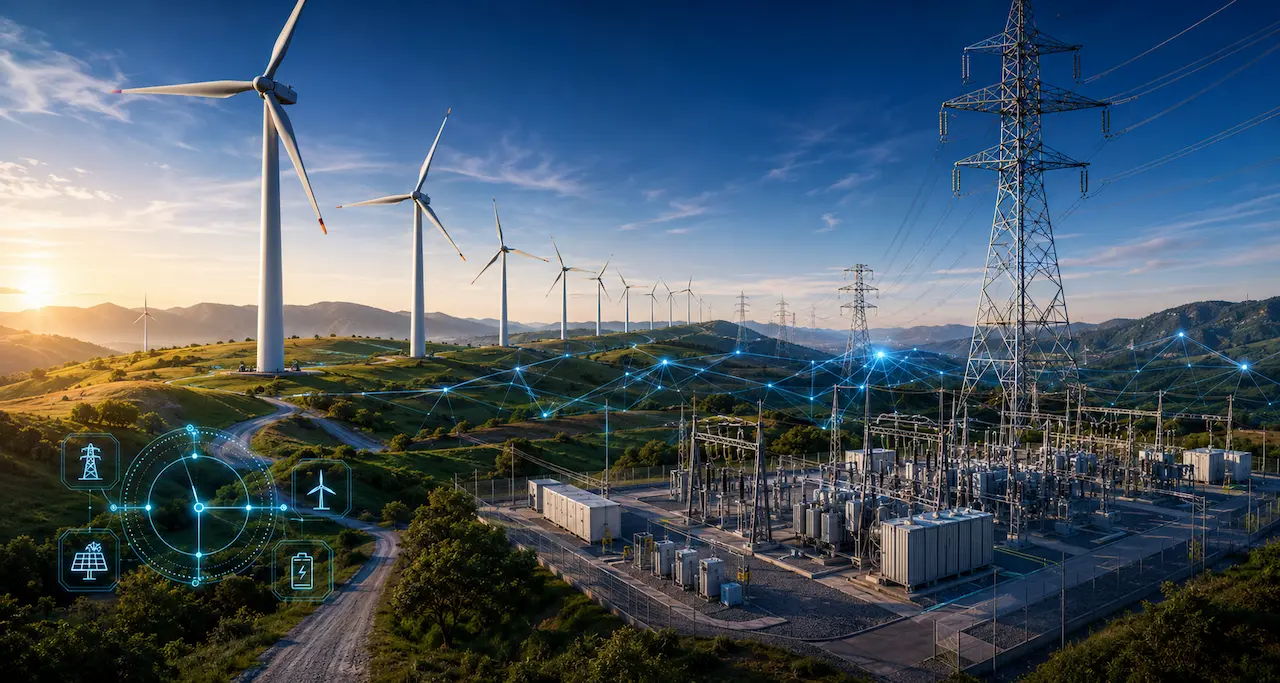
Wind energy represents one of the fastest-growing sectors in North American power generation, and the engineering complexity of connecting multi-hundred-megawatt wind farms to the transmission grid has grown correspondingly.
Modern wind farm electrical engineering encompasses turbine technology selection, collector system design, substation engineering, IBR compliance, and ongoing O&M support across facilities that may span tens of thousands of acres.
Wind Turbine Generator Technologies: Types 3 and 4
Type 3 (DFIG — Doubly-Fed Induction Generator)
The doubly-fed induction generator (DFIG) is a Type 3 wind turbine generator that uses a partial-scale power converter (typically rated at 25-35% of turbine rating) to control the rotor circuit currents while the stator connects directly to the grid through the step-up transformer.
Advantages:
- Smaller, less expensive power converter compared to full-converter designs
- High efficiency across a broad wind speed range
- Variable-speed operation (typically ±30% of synchronous speed)
- Natural provision of some fault current from the directly-connected stator
Disadvantages:
Need Engineering Support for Your Power Project?
American Power Engineers delivers power system studies, substation design, renewable energy engineering, BESS projects, NERC compliance, MEP engineering, and POI interconnection services.
Explore Our Engineering Services- Sub-synchronous resonance (SSR) potential with series-compensated transmission lines
- Complex protection during voltage disturbances (crowbar protection activation)
- Requires more sophisticated EMT modeling for compliance studies
- Lower ride-through capability than Type 4 without specific control enhancements
Type 4 (Full Converter)
Type 4 wind turbines connect to the grid exclusively through a full-scale AC/DC/AC converter, completely decoupling the generator’s electrical frequency from the grid frequency.
Advantages:
- Full controllability of active and reactive power independently
- Superior ride-through capability
- No SSR concerns
- Simpler EMT modeling for compliance studies
- Meets IEEE 2800-2022 requirements more naturally
Disadvantages:
- Higher cost converter (100% of turbine rating)
- Slightly lower efficiency than DFIG under some operating conditions
- Inertia is synthetic — requires specific control programming
Modern offshore wind projects and most large onshore wind projects above approximately 2 MW per turbine use Type 4 technology, while Type 3 remains common in older installed capacity and some lower-cost applications.
Wind Farm Collector System Design
Large wind farms (100+ MW) typically use medium-voltage (34.5 kV) collector systems to aggregate individual turbine output. Key design considerations:
Radial vs. Ring Collector Topology: Radial feeders are simpler and less expensive but result in all turbines downstream of a fault being de-energized. Ring collectors provide a second path to the substation, improving availability at higher cost.
Planning a Solar, Wind, BESS, or Grid Interconnection Project?
Our engineering team helps project owners, developers, utilities, and facility teams move from technical planning to reliable project execution.
View Engineering ServicesCable vs. Overhead Line Collectors: Overhead MV lines are less expensive but require rights-of-way, visual impact considerations, and increased lightning exposure. Underground cables are preferred in most US markets despite higher capital cost.
Reactive Compensation for Long Collectors: Long cable collectors have significant charging capacitance that generates reactive power. At light load conditions, this can cause over-voltage at remote turbines. Shunt reactors or tap changer adjustments on pad-mount transformers are used to manage this effect.
Wind Farm Grid Code Compliance
Wind farms in North America must comply with NERC reliability standards and applicable ISO/RTO tariff requirements that together constitute the “grid code” for interconnection. Key requirements include:
Ride-Through Requirements (NERC PRC-029-1, IEEE 2800-2022): As detailed in our PRC-029-1 guide and IEEE 2800-2022 guide, wind turbines must remain online during voltage and frequency disturbances.
Reactive Power Capability: Wind farms must maintain reactive capability within defined Q-P envelopes at the POI. This may require reactive compensation equipment (capacitor banks, SVCs, or STATCOMs) at the collector substation to supplement the inverter-level reactive capability.
Power Factor Control: ISO/RTO requirements typically mandate power factor control capability in the range of 0.95 leading to 0.95 lagging at rated active power.
Frequency Response: ERCOT and some other regions require wind farms to provide Primary Frequency Response (PFR) by operating in curtailed mode with headroom for frequency-responsive upward ramp.
Our Wind Energy Systems Engineering provide complete engineering support from collector system design through NERC compliance.
Final Thoughts
Utility-scale wind farm engineering is far more than turbine selection and layout. Getting the electrical side right generator technology, collector system topology, reactive compensation, and grid code compliance determines whether a project clears interconnection studies on schedule or ends up back at the drawing board after a utility or ISO review. Type 3 versus Type 4 turbine decisions ripple all the way through EMT modeling requirements and ride-through performance, while collector system topology and cable sizing decisions made early in design directly affect long-term availability and reactive power behavior at the point of interconnection.
As NERC and IEEE 2800-2022 requirements continue to tighten, and as ISOs like ERCOT push more IBR performance obligations onto wind assets, the margin for engineering error keeps shrinking. Projects that build compliance into the design from day one rather than retrofitting it after a failed study are the ones that stay on schedule and protect their bankability. Whether you’re evaluating turbine platforms, designing a collector system, or preparing for interconnection studies, having an engineering partner who understands the full scope of wind farm electrical design is what keeps a project moving from feasibility to commercial operation.
FAQs
What’s the difference between Type 3 and Type 4 wind turbines?
Type 3 (DFIG) turbines use a partial-scale converter rated at roughly 25–35% of turbine output, with the stator connected directly to the grid. Type 4 turbines use a full-scale converter, fully decoupling the generator from grid frequency. Type 4 offers better ride-through and simpler compliance modeling, while Type 3 is less expensive but carries sub-synchronous resonance and protection complexities that Type 4 avoids.
Why do most modern wind projects use Type 4 turbines instead of Type 3?
Type 4 turbines provide full independent control of active and reactive power, superior ride-through performance, no sub-synchronous resonance risk, and more straightforward EMT modeling for grid compliance — advantages that generally outweigh their higher converter cost, especially for offshore and large onshore projects.
Should a wind farm collector system use overhead lines or underground cable?
Underground cable collectors are preferred in most US markets despite higher capital cost, since they avoid rights-of-way constraints, visual impact concerns, and increased lightning exposure associated with overhead medium-voltage lines. The tradeoff is that long cable runs introduce charging capacitance that must be managed with reactive compensation.
Why do wind farms need reactive compensation equipment like SVCs or STATCOMs?
Wind farms must meet defined reactive power (Q-P) capability requirements at the point of interconnection. Turbine-level reactive capability alone often isn’t sufficient to meet these envelopes, so capacitor banks, SVCs, or STATCOMs are added at the collector substation to supplement it.
What NERC and IEEE standards apply to utility-scale wind farm interconnection?
Key requirements include NERC PRC-029-1 for ride-through performance and IEEE 2800-2022, which sets interconnection and interoperability requirements for inverter-based resources, including wind. ISO/RTO-specific tariff requirements such as ERCOT’s primary frequency response obligations layer on top of these baseline standards.
Does a wind farm need to provide frequency response services?
In some regions, yes. ERCOT and select other ISOs require wind farms to provide Primary Frequency Response (PFR), which means operating in a curtailed mode with reserved headroom so the plant can ramp up output in response to a frequency event.
Wind Farm Engineering Consultation | Wind Engineering Services | WhatsApp
Work With American Power Engineers
Expert engineering support for power system studies, substation design, renewable energy projects, BESS engineering, NERC compliance, MEP engineering, and POI interconnection services.
Explore All Engineering Services